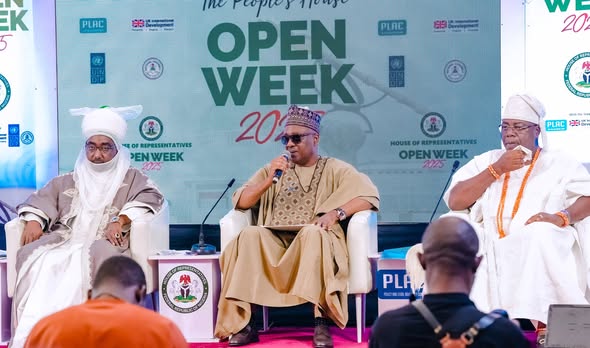
Day Two of the ‘National Assembly Open Week 2025, hosted by the House of Representatives, focused on key constitutional reform issues, featuring robust citizen–legislature engagement and thematic sessions on women’s political representation and the constitutional role of traditional institutions.
The first session, moderated by veteran broadcaster, Eugenia Abu, was centered on the Special Seats for Women Bill. It opened with welcome remarks by Rep. Kingsley Chinda, House Minority Leader, and Dr. Clement Nwankwo, Executive Director of the Policy and Legal Advocacy Centre (PLAC), both of whom emphasised participatory democracy as a foundation for restoring rightful inclusion and unlocking Nigeria’s full leadership potential. They called for broad-based collaboration across government, civil society, and political parties to institutionalise women’s inclusion.
Nigeria’s First Lady, Senator Oluremi Tinubu, CON, represented by Rep. Kafilat Ogbara (APC, Lagos), Chairperson of the House Committee on Women Affairs, reiterated strong support for the bill, stating that women deserve a seat at the table in recognition of their competence and contributions. Hajiya Zainab Abubakar Ibrahim, representing the Hon. Minister of Women Affairs; Hajiya Imaan Sulaiman-Ibrahim, described the bill as a national imperative and a corrective step to redress historical gender imbalances.
Goodwill messages were delivered by William Robinson, on behalf of the British High Commissioner, and Ruben Alba Aguilera, representing the Head of the EU Delegation to Nigeria. Both reaffirmed international support for inclusive governance and commended Nigerian women for their enduring advocacy.
The session featured an highly-interactive panel discussion moderated by Rep. Julius Ihonvbere, CON, House Majority Leader , with contributions from Rep. Fatima Talba (APC, Yobe), Rep. Marie Ebikake (PDP, Bayelsa), Rep. Khadija Bukar Abba-Ibrahim (APC, Yobe), Princess Edna Azura (President, National Council of Women Societies), and Hajiya Zainab Ibrahim (National Secretary, Inter-Party Advisory Council – IPAC).
The second dialogue session, chaired by the Speaker, Rt. Hon. Abbas Tajudeen, PhD, GCON, explored “The Constitutional Role of Traditional Rulers.” Rep. Abdulmumin Mohammed Ari (APC, Nasarawa), alongside other contributors, examined how traditional institutions can be better integrated into Nigeria’s evolving constitutional framework.
Chairing the session, Speaker Abbas disclosed that the 10th National Assembly is actively considering proposals to establish a constitutionally recognised three-tier traditional council system at the federal, state, and local government levels. He outlined plans for a National Council of Traditional Rulers to advise the President, State Councils of Chiefs to contribute to peacebuilding and customary law, and Local Government Traditional Councils to support grassroots development and community security. He also called for financial autonomy and constitutional protections to insulate traditional rulers from political interference.
Speaking on behalf of the royal fathers, the Emir of Zazzau, Amb. Ahmed Nuhu Bamalli, welcomed the proposals and called for the reinstatement of traditional leadership roles, particularly in peacebuilding and community engagement. He recalled that earlier Nigerian constitutions recognised traditional institutions; provisions that were later removed, leading to diminished rural governance capacity.
The House of Representatives remains committed to a people-driven constitutional review process that advances equity, inclusion, and participatory governance.